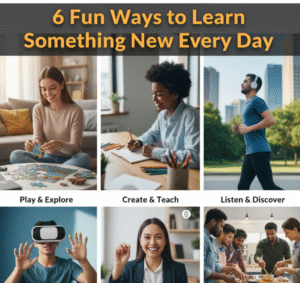
Learn a New Skill in Just Minutes a Day

Introduction: The Power of Small Steps

You do not have to spend hours of free time to get good at something new. The notion that learning involves huge time investments prevents many individuals prior to their initiation. But this is the reality: with a new skill you can learn in a few minutes a day and the outcome will shock you.

Think about it. Five minutes is insignificant. You are likely to spend more time on social media or waiting to get your coffee brewed. However, when you spend the five minutes in a day practicing something, magic will occur. New connections begin to be formed in your brain. Your muscles develop memory. Your confidence grows.

This article will demonstrate to you how exactly to make micro-learning work to your advantage. You will find out which skills are the most responsive to short-time training sessions, how to organize your routine and what errors to avoid. Today the journey begins with a few minutes whether you are interested in speaking Spanish, playing guitar, or writing your first application.

The Reason Why Short Practice Sessions Actually Work Better

Your brain is not built to study in marathons. This is interestingly supported by science.

When you rehearse on something in a burst, your brain remains in full concentration. You are not just putting time into it, but quality time. Once you have spent approximately 20 minutes under a lot of concentration on most tasks, your focus starts to wear off. This is the reason why hours and hours of cramming are so tiring yet non-persistent.

Minimal practicing daily makes a phenomenon referred to as “spaced repetition.” It is at this moment that you repeat something or something that you know. This pattern is a favorite of your brain. Whenever you repeat an action, you reinforce the neural pathways that are linked with that particular skill. It is like putting water to a plant on a regular basis as opposed to pouring a bucket of water on the plant once a month.

There’s also less pressure. In a five or ten minutes case, you cannot make excuses. No time? That’s not true anymore. Too tired? Even on your worst day you can manage five minutes. This eliminates the largest obstacle to the teaching process: the initiation.

Besides, brief sessions avoid burnouts. You will also anticipate your practice time and not fear it. Daily micro-learning habits are much more successful in comparison with conventional learning schedules.

Selecting the Appropriate Skill for Micro-Learning

Not all the skills can be very compatible with the micro-learning approach. Some are perfect for it. Others require more time, in-depth sessions.

Approximately the Best Skills to Use on Short Practice Each Day Include:

Languages are ideal. Five minutes of vocabulary flashcards or pronunciation practice are beautiful to perfect practices with time. You are able to acquire 10 new words in a day, that is 3,650 new words annually. That will suffice to have actual discussions.

The responsiveness of musical instruments to the short-focused practice is incredible. Muscle memory is improved during short sessions rather than occasional long ones. This is used even by professional musicians.

The art of writing is enhanced through practice. Writing only 10 minutes a day will get you perceptibly improved in a few weeks. It is the consistency but not the number of words.

Body-related abilities such as yoga, stretching, or simple physical exercises are most effective in brief classes. Regular movements in your body are more important than an occasional intensive exercise.

Daily practice helps to develop drawing and sketching. A drawing per day will change your skills quicker than you expect.

The work with coding and programming is effective in the form of small lessons and challenges. Numerous successful developers would write 15 minutes in the morning.

Skills Which Require Longer Sessions:

Problems that involve critical thinking and critical concentration may take a longer time to be in the zone. Nevertheless, you can nevertheless move forward by dividing issues into smaller portions.

The skills that involve coordination with others within the team inevitably demand longer intervals of time.

Skills that demand a lot of establishment or movement will not fit well using the five-minute model.

Construction of Your Daily Learning Routine

It is not the amount of minutes which makes the trick to learn a new skill in a few minutes a day. It is making those minutes come each and every day.

Pick Your Perfect Time

Select an occasion that is already part of your schedule. Don’t try to “find” time. Link your new learning habit to something that you have always done.

Get into the practice immediately after you wake up before your brain is clouded by the needs of the day. Or do it in time of lunch. A few of them like the evening when it is just before bed. It does not matter so much what time it is, but what is more important is consistency.

Create a Trigger

Connect your practice with a particular action. “Five minutes after I pour my morning coffee, I practice Spanish.” The habit is automatic with the course of time because of this relationship.

Remove All Barriers

Make the beginning that simple that you never say no. Have your guitar on a stand, not in a case. Keep your language app on the home page of your phone. Drop your sketchbook and pencil on your desk.

Any additional barrier between you and practice is an opportunity to quit. Eliminate those steps.

Track Your Progress

You can use a basic calendar or an app that you will check every day you practice. The view of a series of days completed brings the incentive to continue. You will not like to lose your streak.

The Five-Minute Framework

Following is an effective design on how to get the most out of your short practice sessions:

Minute 1: Quick Review

Begin with a review of what you were learning yesterday. This reinforcement is important. It transfers your learning to the long-term memory.

Minutes 2-4: New Content

Focus on one new element. Just one. Do not attempt to learn several things at once. One new chord. One new phrase. One new technique.

Minute 5: Application of Practice

Implement what you have just studied in the real world. In case you knew a Spanish sentence, recite it orally. In case you have learned a chord on guitar, then give yourself a chance to change to playing another chord you are familiar with.

This framework is effective since it entails review, new learning, and application at the same time. Several forms of engagement are provided to your brain in a matter of minutes.

Overcoming Common Obstacles

There are no easy road runners in trying to ensure one adheres to the daily learning habit. This is the way to break through them.

“I Forgot to Practice Today”

Set an alarm. Make use of the reminder tool of your phone. Write down a note on the bathroom mirror. Make forgetting impossible. Should you forget, then beat not on yourself. Just practice tomorrow. A single day off is not something that will ruin the whole thing, but it is an excuse to quit.

“I Don’t See Progress”

Incremental advancements are difficult to see on a daily basis. It is as though you were observing a child as he grows. You do not see the changes day in day out, but compare the photos taken half a year ago and the difference is striking.

Record yourself. Take photos. Note down what you are able to do, which you were not able to achieve last month. You will be appalled by the evidence.

“Five Minutes Feels Too Short”

That is a nice dilemma. In case you want to practice longer, then do so. But do not make five minutes your maximum, but your minimum. When you are feeling rushed or challenged you will be happy to have a low bar to jump over.

“I’m Not Naturally Talented”

Talent is overrated. Talent cannot beat consistency even once. The individual who practices five minutes a day will be ahead of the so-called talented individual who practices at random. Your commitment in everyday life is your superpower.

Skills That Change as You Use Them Everyday

We will consider particular illustrations of what five to fifteen minutes a day can do:

Skill Daily Practice Results After 3 Months Results After 1 Year
Spanish Vocabulary 5 min flashcards 450+ words, simple conversations 1,800+ words, read simple books
Guitar 10 min chord practice Play 10+ songs Play confidently, write music
Drawing 10 min sketching Clear improvement, simple portraits Professional-like artwork
Meditation 5 min breathing Better focus, less anxiety Significant stress reduction
Push-ups 5 min routine 2x initial amount 3-4x initial amount
Writing 10 min journaling Clarity of thoughts, 30+ pages Published-quality work, 100+ pages

These aren’t exaggerations. These are common outcomes of individuals who practice on a daily basis.

Sophisticated Tricks to Improve Your Progress

The following strategies will help you learn faster as soon as you have made a daily practice of it:

Vary Your Practice Slightly

Do not do as much of the same thing day after day. As long as you are practicing piano, practice various songs or tricks during the week. Diversity in your field of competence does not get you bored and creates more complete competence.

Teach What You Learn

Trying to explain something to someone makes your brain process the information differently. You will conceive it more profoundly. Teach a friend a little of what you have learned in a day, or even simply talk it through with yourself.

Blending Skills Where Possible

Learning Spanish? Write your journal on a daily basis in Spanish. Learning guitar? Do it and practice at the same time you are working on your singing. Integrated practice gives more enriched neural connections.

Making Things More Difficult Gradually

When it is easy, then make it a little more difficult. Add one new element at a time. This keeps you at what is known by experts as the “learning zone” – difficult but possible.

Use Dead Time

You have your way to work or waiting in lines or commercials on TV shows—these are all ideal times to practice. Such instances result in a considerable amount of additional study time.

The Compound Effect of Everyday Learning

The best part about this is as follows: the dividends multiply in unanticipated manners.

Once you show yourself how capable you are of learning a single skill due to practicing it every single day, you will feel like you can learn anything. Such confidence permeates other spheres of your life. You will take work issues in another way. You will do new things that you used to think were out of your reach.

The habit you make is transferred. Given that you can dedicate five minutes of your day to the Spanish language, the same can be dedicated to other good things. Exercise. Meditation. Reading. It is not really the skill, but the person which you are going to acquire in the process.

Your brain improves in learning also. Plasticity of the brain—the capacity of the brain to create new connections—in fact, increases when you engage in habitual learning. The acquisition of each new skill is a little bit easier than the one before it.

Technology Tools That Help

The contemporary applications and systems are tailored to micro-learning. These are the categories worth examining:

Language Learning Apps

These applications work with the spaced repetition algorithms that display you exactly at the time you are about to forget something. The practice sessions last between five and ten minutes.

Skill-Sharing Platforms

Videos can now also provide short lessons on all topics under the sun. Filter lessons by minute to five-minute tutorials.

Habit Tracking Apps

Small applications that allow you to mark every day that you practice. The visual feedback is a strong source of motivation.

Progress Documentation

Take snapshots and videos on your phone of your practice. It is a fantastic incentive to see how you are getting better each week and month.

The tool that will be used should be the best tool. You should not waste time in researching tools as much as you spend in practicing your skill.

True Narratives of Micro-Learning Success

Sarah would have liked to know how to play the piano, but she had a full-time job and two children. She dedicated ten minutes in the morning before anybody was up. In 6 months she performed at the birthday of her daughter. After another year she was writing her own short pieces.

Marcus attempted to study the Spanish language using applications and courses but never followed through. He eventually managed to succeed by dedicating only five minutes per day during his morning coffee. In a year and a half, he visited Mexico and had actual negotiations with people.

Jennifer was always interested in drawing, but she believed that she was not talented. She began to make ten-minute nightly sketches. Her early drawings were crude. She was still improving three months later. One year later she sold her first piece at a local art fair.

These are not special individuals with extraordinary talents. They were ordinary people and thought in the strength of little and regular actions.

Developing a Learning Environment

The success of your application goes more to your physical space than you may believe.

Assign a particular practice location. It doesn’t need to be big. A corner of your desk. A chair by the window. A yoga mat in your bedroom. Your brain is aware that it is learning time when you go there.

Remove distractions. When you are training in five minutes, you are losing every second. Switch off your phone. Close redundant browser tabs. Instruct family members to give you five minutes of silence.

Get into view your learning materials. Don’t hide them away. The visual aid makes you practice even when you are not motivated.

When to Expand Beyond Five Minutes

At some point, you may wish to go deeper into practice. Here’s how to know when:

You are always able to get your five-minute minimum without difficulty. You always desire to work longer than you planned. You are beginning to realize actual results and you want to hurry up. You have at least 30 days in straight practice.

Launch the expansion at a slow pace when you are ready. Increase the number of minutes that you spend per week to ten. Then ten to fifteen. Don’t jump from five to sixty. That is the way people get burnt and leave.

Do not forget, as much as you can increase your practice time, you can use the five-minute minimum as your reserve. You may still manage to achieve that on a bad day to reach that low bar.

The Long-Term Vision

It is not about the skill to know a new one in a day just in a few minutes. It has to do with what you become along the way.

Your character is formed of a person who keeps his word. He or she does not require ideal circumstances to achieve progress. One who realizes that you can attain big things by doing small and constant things.

You might be speaking a new language in a year. You were able to play your favorite pieces upon an instrument. You could have written a book. The new skill set could be absolutely new and you have opened career doors.

Or you might just wish you were where you are and you wished you had begun.

The choice is simple. Not easy, but simple. Five minutes a day. Every day. Starting today.

Frequently Asked Questions

How much time actually does it take to become proficient in a new skill using micro-learning?

In the majority of cases, it is evident that improvement happens after 3 months of practice a day. Authentic competence is normally achieved after 6-12 months, in accordance with the intricacy of the skill. Also, keep in mind that you are developing the same skill level, regardless of whether you spend 5 minutes a day, or consolidate those 35 minutes into a single session a week, but the daily practice develops higher retention.

What should I do in case I miss one day of practice?

It is not a failure to skip one day. Simply get back to your practice the following day guilt-free. The risk is that one missed day will turn into two days then three days. You cannot skip a day in which case you should be back within the day after.

Is it possible to acquire multiple skills at a time with this technique?

Yes, but begin with only one skill until the habit is established (normally 30 days). Then there can be a second skill at another time of the day. It is possible to sustain 2-3 micro-learning habits per day, although quality matters more than quantity and is not an impossibility in most situations.

What is the most appropriate time of day to practice?

The most appropriate time is when you can be the most consistent. The morning practice is effective since it occurs prior to the life becoming hectic. Nevertheless, evening practice is not a bad idea in case you are not a morning person. It does not matter the timing, but the consistency.

What can I do to keep myself motivated when I feel like there is slow progress?

Recording your trip in photos and videos or journal. Go through them after every few months to see the progress you have achieved. Also, keep in mind that action precedes motivation as opposed to the reverse. Do it when one is not motivated, then motivation will come back.

Is five minutes enough or is it mere hype?

Five minutes of practice that are concentrated and intentional truly have an impact because of the memory consolidation process. It is not hyperbole—it is neuroscience. The key word is “focused.” Five lost minutes will not help but five minutes of attention will.

What should I do should I get tired of doing the same thing each day?

Make slight changes to your routine without changing the routine itself. When learning how to play the guitar, practice on various songs or methods daily. In case of learning a language, alternating between vocabulary, grammar, and conversation practice during the week.

Is it costly to begin with?

No. The majority of the skills could be initiated using free resources or minimum cost. There are free versions of language apps. You are able to sketch using pencils and paper. Most of the basics of an instrument may be learned on inexpensive equipment. Poor quality of tools should not be a reason to not begin.

Conclusion: Your Five Minutes Start Now

This is the way to study something new in a few minutes a day that you just read. And the most significant stage is the beginning.

Not tomorrow. Not Monday. Not when you have purchased the best equipment or the best app. Right now. Today.

Choose one skill that you have desired to know. Select a five-minute slot in your timetable. Eliminate all possible obstacles on the way to practice. Then have your first session today.

That’s it. That’s the entire formula. Simple, but not easy. Its beauty is in its simplicity.

In five minutes’ time, you might be through with your initial practice session. In five days, you will have a demonstration about the fact that you are a follow-through person. In five months, you are going to be staggered by what you have achieved.

It is not the number of years or great sacrifices between who you are and who you want to be. It is calculated on five-minute intervals, day by day.

The change that you need begins when you start. So begin. Right now. For just five minutes.

What will you learn?

Leave a Reply

Your email address will not be published. Required fields are marked *

RSS
Follow by Email
error: Content is protected !!